
How often to clean a mini split in Sioux City, IA
Let a pro reach outA mini split works hard in Woodbury County. It cools through sticky summers and carries real heat load once the cold sets in, running most months of the year instead of sitting idle half the time like a furnace paired with central air. That steady use is exactly why the filter, the coil and the condensate drain need checked on a schedule rather than whenever something finally acts up. Skip it long enough and you notice it as weaker airflow or a system that runs longer to do the same job. Finding the right person for this isn't always simple. You want someone local who works on mini splits all year here and knows what tends to go wrong with them in this climate, not a general handyman. Send the request and that search is off your plate. It goes to one contractor, licensed and familiar with this equipment, so you're not fielding calls from a handful of companies trying to win the job.
How often should I clean my mini split in Sioux City?
Your mini split runs most months of the year here, not just a few weeks in summer. You've noticed the filters look dusty faster than you expected, or maybe the airflow from the indoor unit seems weaker than when it was new. Before you call someone out, you want to know what's actually normal upkeep for a system that works this hard in Woodbury County, and how often you should be doing it yourself versus having it looked at.
Clean the filters every two to four weeks and have the full system serviced once a year
The filters catch dust, pollen and pet hair every time the unit runs, and with a mini split working through sticky summers and cold Iowa winters, that buildup happens fast. A filter you can slide out and rinse yourself takes just a few minutes, and doing it every two to four weeks keeps air moving freely across the indoor coil. Skip it for a few months and the unit has to work harder to push air through, which shows up as weaker airflow or higher power use. Beyond the filter, the coils, the condensate drain and the outdoor unit need a closer look once a year. That's where a technician checks refrigerant levels, clears anything blocking the outdoor coil, and makes sure the drain isn't backing up before it causes a bigger problem.




What You Clean, What a Pro Cleans
Filters you clean yourself
- Slide the filters out and rinse them with water every few weeks while the unit is running steadily, more often if you keep pets or run it nonstop through a humid July.
- A clogged filter makes the indoor unit work harder to pull air through, and you'll notice weaker airflow before you notice the higher bill.
- This takes a few minutes and needs no tools, just access to the indoor head and a sink.
- Dust and pet hair build up faster on a mini split than on a furnace filter because the unit cycles on and off so often during the year.
- Skipping this for months lets dust reach the coil behind the filter, which a rinse under the tap won't fix.
What a contractor handles
- The coil behind the filter collects a film that water alone won't clear, and it needs a real cleaning once a year to keep the unit pulling heat or cold efficiently.
- The condensate drain line can grow algae or clog with dust, and a blocked line backs up and drips inside the house before you notice anything wrong.
- The outdoor unit needs its coil and fan checked too, since leaves and lawn clippings get pulled in over a Woodbury County summer.
- Refrigerant levels and electrical connections aren't something to check without training, but a low charge or a loose wire shows up as weak heating or cooling long before the unit fails outright.
- Someone who services mini splits in this area every season knows which models in Sioux City tend to clog their drain lines first and checks that before it becomes a leak.
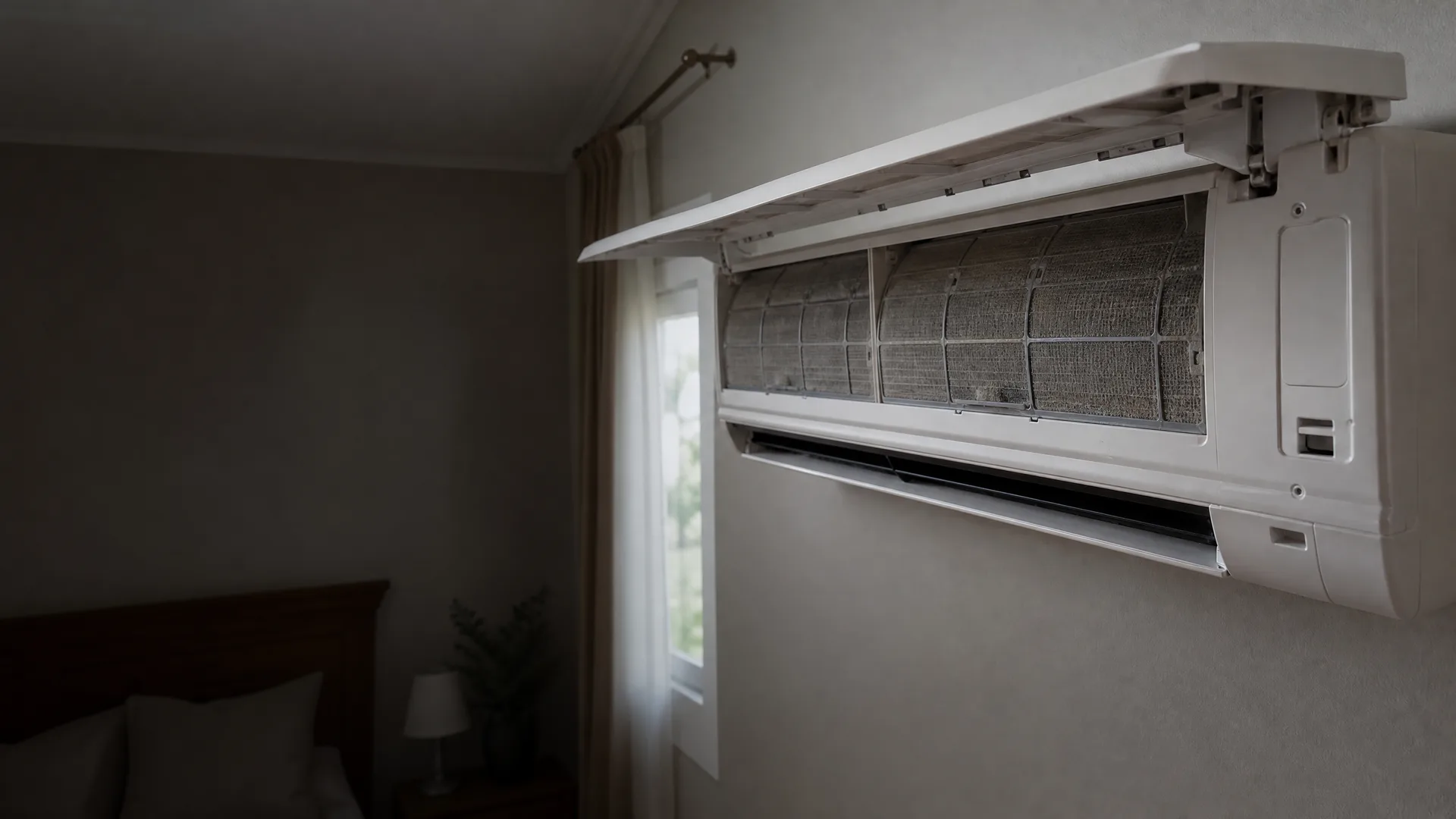
You pop the front cover off the bedroom unit on a Saturday in April, meaning to give the filters a quick rinse before the weather turns warm. The screen is grey with dust, more than you remember from last fall. Sun is coming through the window and you can see it clearly, the fine film sitting across the mesh like it's been building for weeks. You run a finger over it and it leaves a clean streak. The room has felt a little stale the last few mornings, air moving but not quite enough, and now you know why. You carry the filter to the sink.
Stop chasing a mini split pro
The filters are yours to handle, but the coil, the blower wheel and the condensate drain need a contractor's eyes at least once a year, twice if the unit runs nearly year round like most do here. A tech who services mini splits all winter and all summer in this area knows which models in Woodbury County clog their drains first and which coils mildew fastest in a July that won't let up. That's a different thing than a filter rinse on a Saturday afternoon. Skip that yearly visit and the unit keeps running, just harder, pulling more power for less cooling and less heat, and a coil caked with dust or a drain backing up doesn't announce itself until water is on the floor or the system short cycles on a January night. If your filters are already looking grey a few weeks in, that's worth mentioning when you reach out. One local contractor, not a handful, gets the full picture of what you're dealing with.
What a tune-up actually checks
- The indoor unit has a blower wheel behind the filters, and dust that gets past a dirty filter sticks to its fins instead of blowing into the room.
- The outdoor unit has its own coil, and a contractor checks it for leaves, grass clippings and the kind of grime that collects over a Sioux City summer.
- Refrigerant runs through the coil at a set charge, and a tech checks that level because a mini split can't just be topped off without finding the leak first.
- The condensate drain carries off the water the indoor unit pulls from the air, and a clogged one backs up and drips into the room instead of outside.
- A tech checks the electrical connections at both units, since a loose wire at the outdoor unit shows up as a system that short cycles or won't start in cold weather.
- The remote sensor and thermostat calibration get checked too, because a unit reading the room wrong runs longer than it needs to either way.
You can see the filters. The rest of the system is harder to check from your side, and it's where most of the real work happens. Behind the filters sits the blower wheel, and once dust gets past a filter you forgot to rinse, it sticks to those fins and stays there, cutting airflow even after you clean up front. Outside, the condenser coil collects whatever the yard throws at it over a summer, grass clippings, cottonwood fluff, dust, and a contractor clears that off so the unit can actually shed heat. Inside that coil runs a fixed charge of refrigerant. Low charge means a leak somewhere in the line, and a mini split can't just be topped off the way an old window unit could. Finding the leak comes first. The condensate drain is another spot that fails quietly. It carries water pulled from the air in your house out to the outdoor unit, and when it clogs, that water backs up into the indoor unit instead, sometimes dripping onto the wall below it before you notice. A tech also checks the wiring at both units. A loose connection at the outdoor unit is a common reason a system short cycles in summer or refuses to start on a cold January morning. Last on the list is the thermostat sensor itself. If it's reading the room wrong, even by a couple of degrees, the unit runs longer than it needs to, every single day.
Why does my mini split need cleaning nearly all year?
Cooling runs June through August
Cooling runs June through August, so the indoor filters and coil are pulling humid summer air for three straight months without a break.
Heat runs October through May
Heat runs October through May, which means the same unit switches jobs and keeps working filters and coils for eight more months after summer ends.
Power here costs 11.49 cents per kilowatt-hour
Power here costs 11.49 cents per kilowatt-hour, cheap enough that a dirty coil or clogged filter adds more to your bill through strain than through the rate itself.
NOAA nClimDiv 1991-2020 · EIA-861 2025
Rinse the filters yourself every few weeks while the unit is running, and get the coil, blower wheel and condensate drain checked once a year, twice if the unit runs through both the summer and the winter like most do around Sioux City. That's the whole answer. What changes is how quickly you act when something looks off between visits, a line of dust on the blower, a drain that's slow, a coil that's starting to ice up. A contractor who works on mini splits all year in Woodbury County has seen what a Sioux City summer does to a dirty coil and what a hard winter does to a neglected drain line, so the visit isn't a guess. You're also not handing this off to a crowd of companies calling at once. One licensed, local contractor gets your request, the kind who already knows what tends to fail on this equipment in this area, and takes it from there.

Send one request and you're done looking
The pro who gets in touch is licensed in Iowa and works in Woodbury County.